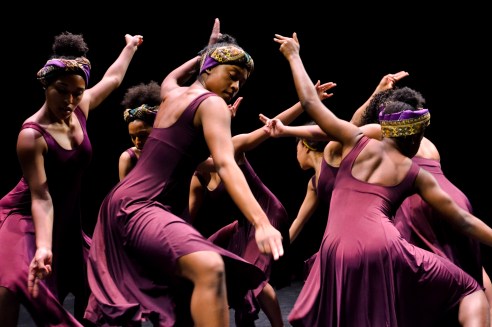
~ The Color Book made its debut in the Senior Concert, March 6th – 8th, 2019 in the Barnett Theatre at the Ohio State University. It is a two-part dance narrative about colorism from the African American female perspective. The first section that I performed in is entitled Foreword. It is a three-minute solo performed to a live spoken word artist. The second section, entitled Chapter One, is a six-minute work performed by the ensemble. The Color Book identifies the stereotypes associated with skin color on the black spectrum to celebrate black female life through dance. Upon its completion, The Color Book attempted to reconstruct the image of Black women in dance by understanding their existence and reclaiming their identity.
Chapter One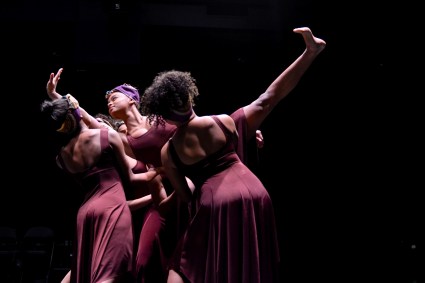
Chapter One, which is the ensemble work, generated movement differently. The Color Book’s dance community consisted of women who identified with African lineage: ten dancers, a spoken word artist, an assistant, and a lighting designer. My rehearsals started mid-October in 2018, with 2-hour rehearsals twice a week. At the start of the first rehearsal, I asked my dancers a series of questions to grasp a better understanding of their identity and how they viewed themselves. These questions include, “Have you heard of the word colorism before?”, “Do you know what this word means?”, and “How do you identify as a person in this world?”
After this discussion, I told my dancers my goals for this work and proceeded to teach them about colorism and the knowledge I learned. In my Slavery in the U.S. class, I learned (in depth) about racism. Racism, where colorism stems from, transcended 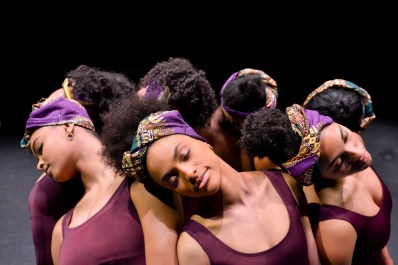 through slavery at the peak of the Atlantic Slave Trade towards the end of the 17th century. The Caribbean, home to the most successful European powers of the slave trade, catapulted the Atlantic Slave Trade to transport 12.5 million Africans to the “New” world. In Barbados 1661, the Portuguese implemented the first set of slave codes. These codes reconstructed and then applied by the U.S Virginian government in 1705, became the first comprehensive slave codes in the British colonies. These laws made the terms “slave” and “black” synonymous which restricted black life from then on.
Through online research and discussions, I learned about the Willie Lynch theory. Today, this theory creates a debate around its authenticity because it is unclear who wrote it and when it was written. While it has been rejected among modern day historians, the theory migrated through public Black schools and literature. This theory has affected the African American community by changing the dialogue between fellow Blacks. This controversial piece of writing constructed the house slave and the field slave debate. A field slave was a dark skin toned African/African American, working in the fields of the plantation starting in the 18th century. House slaves were descendants of rape between a black female slave and a white male plantation owner. It was believed, among the slave population, that these children received benefits because they were kin to the white family. Some of these benefits were as small as more food or as large as the learning how to read and/or write which was illegal during this time.
I used this information in various ways during the choreographic process. I instructed the dancers to recall a time when they may have experienced colorism. I left the concept open-ended because I realized they were still unfamiliar with the term. I gave them the freedom to recall moments dealing with race with white vs. black people, and black people within the black color spectrum.
After a few minutes, I asked the dancers to write down these memories. Once they finished, I told them to not discuss their stories because we were going to use those narratives to create the movement for their solos.
The movement created from their solos served as motifs – a distinctive feature or dominant idea in an artistic or literary composition. The solos consisted of four, eight counts of movement that originated in the dancer’s personal dance aesthetic. Their solos were then taught with the notion to empathize with that person’s story. One example iscentered around one of my dancer’s movement in a weighted lunge that chugged through space. The right hands’ palm faced the forehead with the fingers extending outward and the left hand was placed on the chest. This piece of choreography is meant to represent emotional strain on a person with a trajectory at the mind and the heart. This specific move showcased unity among the dancers because they gravitated around a common struggle with their identity. That common ground is being judged by their own community based on the lightness/darkness of their skin.
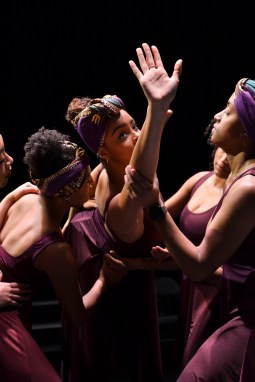 Structurally, these solos served as a powerplay against the passing theory I have discussed previously. Systematically, light/fair skinned dancers receive more opportunities to dance on stage like leading roles in prestigious ballets. Some dark-skinned dancers are pushed towards ensemble work or not considered at all. For The Color Book, I wanted to fight that. While all dancers created a solo, I specifically used dark skin and light skin dancers to have solo moments throughout the piece. I also chose to leave the entire ensemble onstage when a solo was present to counteract the ideology of light skin as supreme. Furthermore, this contributed to the community aspect in African traditions which was important in the creation of my work. I speak on this community aspect later in the paper when I talk about African concepts I used.
 Brianna Rhodes